
CONTACT ECZEMA
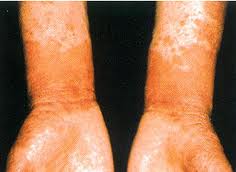
Contact eczema can be divided into two types of eczema, which are referred to as allergic contact dermatitis and direct irritant contact dermatitis. Allergic contact dermatitis refers to exposure to various agents or acids or alkaline products that have a very extreme high alkalinity such as Clorox or other bleaches. Also many common home detergents can cause eczema after repeated exposure. The exposure can happen at your factory, office or even at home.
Allergic contact eczema most often occurs when the skin is already sensitive from the past for some good reason. So the skin is much more sensitive to any new 'agent or cause' that will cause the allergic reaction. And those in need of a treatment for contact eczema or any type of eczema may choose Eczema-Ltd III to meet their needs. As the old saying, "You cannot lose anything but your eczema".
ALLERGIC CONTACT ECZEMA
Allergic contact eczema is problematic simply because of repeated 'contact' with and irritating agent or chemical or anything that irritates the skin. Often it is the repeated contact 'over time' such as the skin contacting belt buckles or the chemical from cleaning of the belt buckle. Many metals can cause irritation ranging from earrings to rubber cement. Try to think of what you have used lately or something that your skin rubs against fairly often or in 'contact with'. You may learn much more of allergic contact eczema at Eczema-Ltd III.
And for more information, you may visit the American Osteopathic College of Dermatology to learn more of allergic contact eczema or dermatitis at Allergic contact dermatitis which is caused by your body's reaction to something that directly contacts the skin .
IRRITANT CONTACT ECZEMA
Irritant contact eczema is exactly what the name states of 'irritants that the skin comes into contact with that causes eczema'. Obviously they are some item that the skin is not accommodating and very much unlike the skin, thus the irritation. The list of irritants can range from gasoline spilled when fueling your car or lawn mower to chemical used to clean paint brushes and onward to very common household cleansers and detergents. Enough contact causes the irritation over time. Excellent moisturizers are pure jojoba oil and Safflower oil.
This is a condition that becomes more common as people get older. There are two types of contact eczema:
- Direct irritant contact dermatitis: due to physical damage to the skin caused by friction or certain chemicals. The rash occurs at the point of direct contact with the skin.
- Allergic contact: due to exposure to an allergen that sensitives the immune system resulting in an antibody response. Further contact with the allergen causes an increasing level of antibody response with the rash developing on other parts of the body other then the point of physical contact.
Symptoms include scaling and thickening of the skin. Itching occurs where the skin has been in contact with a particular allergen such as cosmetics or nickel in jewelry or irritants such as soap or water. In two thirds of contact dermatitis cases the hands are involved because of sensitizing agents the sufferer has encountered at work and even the home. Common allergens are plants, formaldehyde, and and almost any other product that you can look through your shop or garage that you may have come in contact with recently.
People working in certain occupations are particularly prone to contact eczema. It is common in hair dressing, nursing, housework, car workers, interior decorators, building workers and workers who come in close proximity to chemicals. Certain items cause particular problems. These include latex, which is currently in widespread use in gloves, condones and balloons and is posing a significant occupational hazard. Increasing numbers of healthcare workers are now encountering latex allergy in the course of their work. Prevention is the key to dealing with eczema. People with this allergy should try to avoid latex in the course of their work and in receiving treatment themselves from doctors and dentists who may use latex gloves. Keeping the hands clean, moisturizing the skin after hand washing, first aid for cuts and scrapes and wearing gloves are all useful preventive measure in the workplace.
LICHEN SIMPLEX
Rubbing and/or scratching by eczema sufferers over a prolonged period causes areas of thickened skin to develop. This is most commonly found on the lower limbs and the nape of the neck. Potent treatment may be needed to relieve the intense itch in these thickened areas, however the potent treatments often have side effects.