
 |
NAIL
PSORIASIS

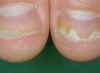
Psoriasis
can affect both the toenails and fingernails. Commonly it appears as
pits in the nails of various size, shape, and depth. Sometimes the nails
develop a yellowish color and become thick. The nails may crumble easily
and be surrounded by inflammation. Another possible symptom is
detachment of the nail from the nail bed. Psoriasis can affect the
connective tissue that forms the nails. Pitting of the nails may be an
early sign of nail psoriasis, although pitting can also occur in other
diseases. Other signs of nail psoriasis include the appearance of dark
spots resembling oil droplets on the nails, the build-up of flaky skin
cells under the nails, and separation or loosening of the nails from
their beds (onycholysis). One or more nails may be affected.
Psoriasis of the fingernails and toenails is common but can be very
difficult to treat. The nails may start to separate from the nail bed.
During this process, the nail becomes whitish in appearance. Sometimes
it becomes so badly damaged that it starts to crumble.
About 50 percent of persons with active psoriasis have psoriatic changes
in fingernails and/or toenails. In some instances psoriasis may occur
only in the nails and nowhere else on the body. Psoriatic changes in
nails range from mild to severe, generally reflecting the extent of
psoriatic involvement of the nail plate, nail matrix (tissue from which
the nail grows), nail bed (tissue under the nail), and skin at the base
of the nail. Damage to the nail bed by the pustular type of psoriasis
can result in loss of the nail.
Nail changes in psoriasis fall into general
categories that may occur singly or all together:
-
The
nail plate is deeply pitted, probably due to defects in nail growth
caused by psoriasis.
-
The
nail has a yellow to yellow-pink discoloration, probably due to
psoriatic involvement of the nail bed.
-
White
areas appear under the nail plate. These are air bubbles marking
spots where the nail plate is becoming detached from the nail bed (onycholysis).
There may be reddened skin around the nail.
-
The
nail plate crumbles in yellowish patches (onychodystrophy), probably
due to psoriatic involvement in the nail matrix.
-
The
nail is entirely lost due to psoriatic involvement of the nail
matrix and nail bed.
Psoriasis
of the nails can resemble other conditions such as chronic infection or
inflammation of the nail bed or nail fold. Psoriasis of the toenails can
resemble chronic fungal infection of the nails.
A person with psoriatic nails should avoid any injury—bumps, scrapes,
etc.—that may trigger a worsening of psoriasis (Koebner’s
phenomenon). Nail psoriasis is treated by the dermatologist as part of
the overall treatment of the disease.
About one-third of people with nail psoriasis may have a fungal
infection, which, if treated, could help their nails to improve. Some
treatments used for skin psoriasis also may improve the condition of the
nails. Consult with your physician to learn which treatment may be best
for you.
If your nails are affected by psoriasis, try
the following:
-
Trim
your nails to reduce the risk of injuring them; trauma can worsen
nail psoriasis.
-
Try
soaking affected nails and follow up with moisturizer. Carefully
file thickened toenails with an emery board after soaking.
-
Reduce
toenail pressure and friction – which can cause toenails to
thicken -- by wearing well-fitted, roomy shoes.
-
Consider
using nail hardeners or artificial nails that can help to improve
the appearance of intact nails.
-
Talk
to your physician if deformed nails are a problem for you. They may
be surgically removed and replaced with artificial nails.
Nail
pitting looks as if a biro tip has pushed a dip into the nail and there
may be up to 10 on each affected nail. Having pits in the nails does not
mean that the psoriasis is going to behave any differently than if there
are no nail pits present. No treatment is available for nail pitting and
it is not usually necessary to treat this anyway. Nail pitting does NOT
mean that other types of nail problems will arise.
Nail psoriasis is frequently associated with
psoriatic arthritis.
Onycholysis is when the nail bed develops a build up of keratin causing
the nail to appear white when it is viewed from above. It usually starts
from the end of the nail and works back. This may be the only sign of
psoriasis and may affect only one finger or toenail alone and there may
be no other skin rash of psoriasis. Onycholysis may affect only one
fingernail and never become more extensive, but in some people it can
affect more than one nail. There is no way of predicting this. The nail
can lift off from the nail bed and the nail can sometimes be lost. It
may or may not grow back normally.
Occasionally the build up of keratin beneath the nails in psoriasis can
be very marked and lead to the affected nail becoming thickened and
raised. When this happens it is called Onychodystrophy. This can be sore
and painful and some sufferers may also find the appearance embarrassing
due to comments made by others. The other diagnosis could be a fungal
infection of the nail in which case clippings of the crumbly keratin
beneath the nail should be sent for culture. Sometimes it can be
difficult to tell between the two.
Triggering factors are events or conditions
that cause psoriasis to flare up or worsen:
-
Skin
injury. Injury or trauma can make psoriasis worse. This feature of
the disease is called the Koebner phenomenon. Patches of thick,
flaky skin may appear following a burn, graze, or rash. If someone
is prone to outbreaks of psoriasis, it is important to promptly
treat rashes such as those caused by allergies to medication.
Otherwise, the rash could lead to a flare-up of psoriasis.
-
The
Koebner phenomenon occurs in about 1 in every 4 people with
psoriasis. Why it happens is not known. It occurs most frequently in
people who develop psoriasis early in life (before age 15).
-
Drug
reactions. Certain medications may make psoriasis worse. These
include lithium (prescribed to treat bipolar disorder, beta blockers
(prescribed for heart problems), anti-malarial drugs, and
nonsteroidal anti-inflammatory drugs (NSAIDs) such as ibuprofen
(available by prescription or over the counter for pain relief).
-
NSAIDs
are often used to treat psoriatic arthritis. In such cases, the
benefits and risks of treatment need to be carefully assessed.
Flare-ups of psoriasis caused by NSAIDs usually respond to
treatment. Abuse of alcohol, on the other hand, can make psoriasis
treatment ineffective.
-
Climate
change. Lengthy exposure to a dry climate with low relative humidity
can make psoriasis worse. For many people, sun exposure during the
summer helps to clear psoriasis. However, people who are
sun-sensitive find that psoriasis flares up when skin is exposed to
the sun.
-
Stress.
Severe emotional stress may play a role in the appearance of
psoriasis or in flare-ups of the disease. However, the impact of
stress can be difficult to assess. Techniques to reduce stress can
be helpful if flare-ups of psoriasis follow a pattern and stress
factors can be recognized as part of that pattern.
-
Infection.
Strep throat can lead to guttate psoriasis in children and young
adults. Anyone with psoriasis who gets strep throat should be
treated promptly with antibiotics to prevent a flare-up of
psoriasis.
-
HIV
infection can cause psoriasis to flare up or to appear for the first
time. Severe forms of psoriasis, such as inverse psoriasis, become
more common as HIV infection progresses and the immune system
becomes weaker.
|