
INVERSE or FLEXURAL PSORIASIS
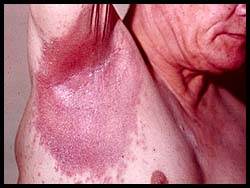
Flexural psoriasis is named as such because it appears in the areas that 'flex'. Also it is called 'Inverse Psoriasis' derives it's meaning from 'reverse or opposite'. Therefore flexural or inverse psoriasis is found on in skin folds behind the knee and not the front of the knee. Likewise, it is found in the groin, or skin folds such as armpits or behind bottom cheeks that rubs together. Most often, it is a red rash area with red lesions or bumps without pus and without scales that is caused by friction and sweating of the skin folds in the above close area. 'Flexural or Inverse Psoriasis' only affects about 2% to 3% of the population. Due to the abrasion and sweating, flexural or inverse psoriasis can be very uncomfortable.
Sometimes there is a crease in the center of the patch that may crack open, bleed or become infected. The rubbing together and sweating of the skin folds aggravates irritation of the affected areas. Inverse psoriasis appears in the body folds; the armpits, under the breast, skin folds of the groin, buttocks, and genitals. Inverse psoriasis is also known as flexural because is occurs in the folds of the skin. Flexural psoriasis rarely occurs by itself. It is more likely to accompany common plaque psoriasis. Psoriasis sufferers in their middle years or old age are more susceptible to this type of psoriasis as are people who are overweight and have more folds of skin.
Due to the location of these lesions, treatment for inverse psoriasis is often very difficult. Steroid creams and ointments are often used, and have found to be fairly reliable, but due to side effects treatment must be kept to a minimum. Steroidal treatments, such as hydrocortisone, can cause skin thinning and other side effects. Additional difficulties arise with treating inverse psoriasis due to the locations of the lesions being prone to fungal and yeast infections. Due to this problem, doctors may dilute the treatments by including anti fungal or anti-yeast agents. Perspiration and friction, difficult to avoid in the flexure areas, only make the condition worse. There is one other product that has been on the market and looks very promising.
Both ultraviolet B (UVB) type light can be helpful with the patient being undressed at the doctor's office. Some studies has reported 60% of the patients got up to "90% clearance" after using up to 10 light treatments. This shows that obviously sunlight can help the patient also at a less expensive price." Or you can try some light treatment from the natural light of the sun can help, but try to avoid direct sun light during the mid-day hours.
Other Natural Treatments:
- Cows Milk
- Vitamin D
- Alkaline Water (Tap water) increase your daily intake
Things to reduce the onset of Inverse/Flexural psoriasis:
- Stop Smoking
- Avoid Alcohol
- Avoid Sodas
- Get Plenty of Sleep (8 hours)
- Reduce Stress by relaxation, exercising