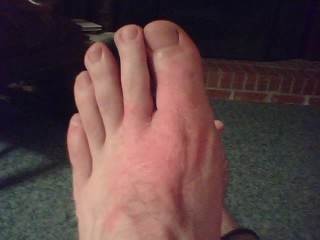
Foot Eczema
Foot Eczema in Adults & Children is very painful as all walking or movement of the foot causes pain and problem. Foot Eczema can easily be solved.
Foot eczema in adults and children is a skin condition that generally presents in adults of all ages and boys between 3-15 years of age, but it may also occur in adults and females. When it occurs in children the prognosis is one of gradual improvement. Children's eczema, also known as 'juvenile plantar eczema' has a tendency to be more severe during the summer months when heat and humidity cause the feet to perspire and sweat. The many synthetic materials and chemicals used in the manufacturing process for shoes and socks are a contributing factor in the occurrence of foot eczema. Sweat retention and covering of the feet by woolen or polyester socks aggravates this condition, whereas cotton allows the skin to breathe. Keeping the foot for a long time in a shoe or sock without aeration is an important triggering factor. Changing to leather footwear and wearing cotton socks may help relieve the problem. It is also important that the footwear fits well and the sole of the foot is not sliding against the insole of the shoe. Walking barefooted on woolen or polyester carpets may contribute to juvenile plantar eczema as this may lead to static electric charges that may play a role in skin dryness and irritation of Juvenile plantar eczema.
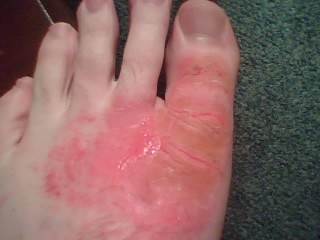
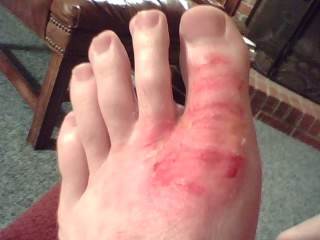
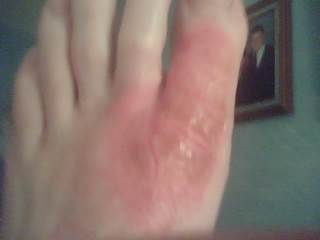
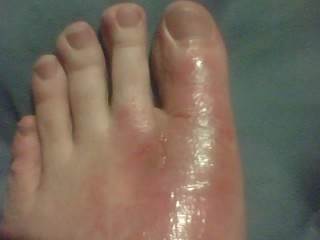
Foot Eczema in children or adults is best solved with the use of Eczema-Ltd III. This foot eczema is characterized by smooth, red appearance of the skin with cracks and scaling. The sole of the foot becomes red, hot, and sore.
The common signs of foot eczema are redness, irritation, cracking, and a general soreness or pain, itching is seldom reported. The plantar surfaces of the larger toes are usually the first areas to be involved. Other weight-bearing areas are subsequently affected, but there is relative sparing of the instep and inter-digital web spaces of the foot.
Foot eczema is characterized by the sudden onset of clear blisters. These blisters are followed by scaling, thickening, and in some instances painful cracking of the skin. In some case there is a bacterial infection is a common complication with Juvenile plantar eczema. To help reduce juvenile planter eczema (foot eczema) you can wear socks that are 100% cotton and wear a shoe that breathes naturally. Follow these recommended options and treatments for at least 4 months after skin has healed. It takes a long time for skin to recover, and unless you're careful the eczema will reoccur.
Foot Eczema is also known as 'juvenile plantar dermatitis', 'forefoot dermatitis', 'atopic winter feet', 'dermatitis plantaris sicca', 'forefoot eczema', 'peri-digital dermatitis', 'sweating sock dermatitis'.
Foot eczema problems is often is often caused by modern footwear and is more common in males, usually during puberty. It causes the sole of the foot to become red, hot and sore with a red appearance. The inflammation is triggered by friction of the sole of the foot inside an ill-fitting synthetic athletic shoe or trainer. It has become particularly common in recent years since 'trainers' became fashionable. Changing to leather footwear and wearing cotton socks may relieve the problem. Above all else, it is important that the footwear fits well and the sole of the foot is not sliding against the insole of the shoe.
| ||||