
SEBORRHEIC DERMATITIS
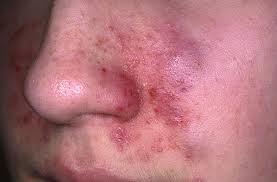
Seborrheic dermatitis also known as Dandruff or Seborrheic eczema is a skin condition characterized by white to yellowish, greasy or dry, loose scales, with or without associated reddened skin. This condition is called Cradle cap in infants.
Seborrheic dermatitis is scaly skin normally found on the face and scalp where there is an abundance of sebaceous glands. However, any part of the body could have the seborrheic dermatitis symptoms.
Seborrheic dermatitis appears to run in families. Some common triggers for seborrheic dermatitis include stress, fatigue, weather extremes, and lotions that contain alcohol.
Seborrheic dermatitis can be unpleasant, scaly and itchy skin can be uncomfortable. It can disappear spontaneously and suddenly reappear, for no known reason. Or it can stubbornly linger, resisting treatment. But as frustrating as it can be, it is readily diagnosed and is treatable.
You may look at Dermatitis-Ltd III, they offer 120 day 100% refund of they product if unhappy
Seborrheic dermatitis begins gradually, with dry or greasy scaling of the scalp. The affected areas are oily and red, and may or may not be itchy.
Seborrheic dermatitis on the scalp is known as 'dandruff' which is a flaking scaling of the skin on the scalp. Seborrheic dermatitis normally goes away on it's own but often reaper and disappears again. A severe case of 'dandruff' could become full blown seborrheic dermatitis if it is scratched often and long enough over several weeks. And there is always the chance that an infection can occur to make the simple case more severe.
The diagnosis is based on the appearance and location of the skin lesions
When lesions are on the scalp, seborrheic dermatitis and psoriasis may be almost indistinguishable from one another. In patients with a genetic predisposition to psoriasis, seborrheic dermatitis is believed to trigger psoriasis or evolve into psoriasis.
Seborrheic dermatitis is relatively common in the United States with 5 percent of the population having it. Elsewhere within the world, the percentage could be considerably higher due to suppression of the immune system in some countries.
Symptoms are long term scaly skin that usually forms in the sebaceous gland areas of the face, ears, between the eyes and eyebrows and very often in the scalp. When found in the scalp, the common name is dandruff of which about 15 or 20 percent of the population has to some degree.
The exact cause of Seborrheic dermatitis is unknown. Yeast called Pityrosporum ovale, may be a factor in the development of Seborrheic dermatitis. This member of the fungus group is quite common and is found on healthy skin. For people with Seborrheic dermatitis, when the skin retains oil and scales, this organism grows rapidly and can aggravate the skin condition. That’s why some people with Seborrheic respond well to treatment with soaps or shampoos containing antifungal agents.
Treatment varies, depending on the affected areas and the severity of the condition. Mild cases can be treated with medicated shampoos and application of over-the-counter products. For more stubborn cases, consult a physician who can confirm the diagnosis. Such cases may require consultation by a dermatologist.
If the patient suffers from an oily face. The patient should wash their face at least 2 times a day with a soap that will control the oil. Where there is seborrheic dermatitis daily shampooing with a non-prescription shampoo is recommended. Theses shampoos can be medicated or non-medicated.
Adult seborrheic dermatitis has symptoms of a long term skin condition with dry scaly skin that begins with a slight pinkish skin that does not heal. Then shortly if not improved, a seemingly protective scaly area grows that is actually the old dead skin shedding to protect the new skin. Most often the itching symptom exist. Most often adult seborrheic dermatitis grows in the areas with a large amount of sebaceous oil glands which supplies an abundance of oil to the skin. Soon the oil dries and begins to crust and flake. Most sebaceous glands are located on the face as well as the scalp.
Shampooing Tips-Scalp:
- When buying a shampoo make sure it contains one of these ingredients:
- zinc pyrithione
- coal tar
- salicylic acid
- selenium sulfide
- We recommend washing your hair no less three time a week and if possible once a day
Make sure you have the instruction carefully on the shampoo bottle. Some will say let the shampoo set for 3-5 minutes. While others may say keep it in longer.
Cradle cap does occur sometimes in children soon after birth and up to age three. The symptoms are of a scaly patch of scales on the crown of the head, ears, nose and almost any other area less frequently.
Cradle cap harmless to the child and is only a temporary cosmetic condition that normally goes away shortly. Cradle cap is not caused an allergy or poor hygiene. Itching can occur but does not always exist. However, try to control your child's scratching as more irritation of the skin can occur with bleeding and always with a possibility of an infection.
Treating Cradle cap in infants:
- Moisten the skin and message the area with small scales with your finger tips or with a soft brush to gently remove the scales if they are loose. Of course, do not force them off as the condition is cosmetic in nature.
- Shampooing your child's hair no more than daily will be helpful in removing the old scales. A gentle baby shampoo should be used. Normally the washing of the scalp is not needed more than two or three times per week.
- Be sure to rinse off all soap. Thoroughly rinse and towel dry. Brush your child's hair with a clean, soft brush after each shampoo and several times during the day.
- If scales persist, you may use Jojoba oil or Safflower oil to gently message a few drops on the scaly area. Jojoba oil is found in health stores such as GNC or Safflower oil which is commonly found in grocery stores for 1/5 the cost. Leave the small amount of oil on the scaly patch until the next shampoo or bath.
If the infants cradle cap develops becomes infected with a red area that drains fluid and has the appearance of an infection, please contact your pediatrician.
There is no way to prevent Seborrheic dermatitis. While it can be treated and controlled, it cannot be permanently cured. Treating Seborrheic dermatitis requires the patient to have patience — treating this condition can last up to many months if not a years or more.
When the condition is under control the patient the emotional stress is gone. Plus the embarrassing flakes will be brought to a minimum or completely gone. Remember to follow your diet as well to control any further out breaks.