
Arthritis Psoriasis (PSORIATIC ARTHRITIS)
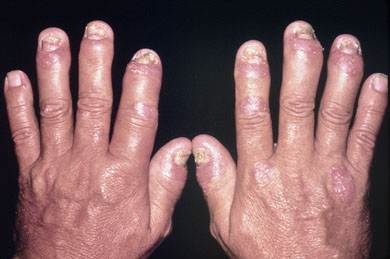
They are times that psoriasis and arthritis can occur together. The most easily recognizable form of Arthritis Psoriasis (psoriatic arthritis) affects the joints of the fingers and toes. Arthritis Psoriasis (psoriatic arthritis) is usually less painful than rheumatoid arthritis. It also usually causes less disability.
Arthritis Psoriasis (psoriatic arthritis) generally affects the fingers and toes, but it can involve the wrists, lower back, knees and ankles. Arthritis Psoriasis (psoriatic arthritis) can be a serious disease, with a large percentage of patients reporting that their symptoms limit their work or home activities.
Arthritis Psoriasis (psoriatic arthritis) usually appears between the ages of 30 and 50. Its symptoms usually include at least one of the following:
- Pain in one or more joints
- Movement that is restricted by pain in the joint or surrounding areas
- Morning stiffness
- Eye pain or redness
Because there is no laboratory test for arthritis psoriasis (psoriatic arthritis), people with psoriasis and joint pain may want to consult a specialist in joint diseases, called a rheumatologist, to evaluate their symptoms. Other joint diseases such as rheumatoid arthritis, gout, and Reiter’s syndrome (arthritis that produces pain, swelling, redness, and heat in the joints) all may be confused with arthritis psoriasis (psoriatic arthritis).